Longboard Sanders for Boatbuilders
If you've ever admired a boat with a mirror-like varnish or paint finish, there was probably some "longboarding" involved.
A nice-looking finish on a boat is the result of a long sequence of methodical steps. For the really ugly blobs of epoxy, we're big fans of random-orbital sanders, of course. That'll get you most of the way there. What makes a great finish is a surface that is perfectly "fair," with no high or low spots.
Whether you're building a 300-foot motoryacht at a giant yard in the Netherlands, or knocking together a kayak in your garage, the concept of a longboard is the same: sandpaper stuck to a long plank bridges low spots and cuts down high spots. It's a reliable way to create a uniform surface that will shine like a mirror.
Boatyard regulars who have a long acquaintance with longboards are heard to call them "murderboards," especially if they're obliged to use them while lying on their backs beneath a big boat. This writer prefers the term "equalizer" for longboards. A longboard with good sharp sandpaper can equalize and smooth a bumpy hull like nothing else in the tool kit.
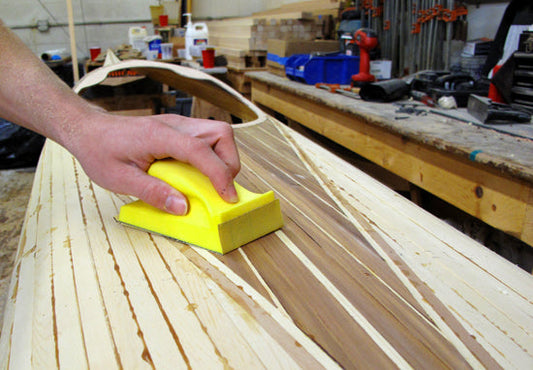
Longboards are good for all sorts of smoothing chores, but they're a "killer app" for fairing strip-planked hulls and decks. That's a Shearwater 17 Hybrid deck, above.

A longboard is a hand sanding tool made from a long, narrow, slightly flexible board. Here's a pile of them from CLC's shop. A factory-built longboard is at the bottom. The store-bought variety are elegant but not demonstrably better than the one you whipped up out of scraps!
For smaller boats, a 3-inch-wide piece of quarter-inch plywood makes a great longboard. A length of 18 to 24 inches is a good place to start, though you might find yourself creating a collection of different lengths and flexibility for different jobs. Areas of a boat hull that are relatively flat benefit from stiffer, longer, less-flexible longboards. 
Just by changing the direction of the grain in a plywood longboard—lengthwise at top, athwartships at the bottom—you can vary the stiffness of your longboard.
Add a couple of handles at either end of the longboard. The handles can be simple blocks, or elaborately ergonomic, as suits your taste and temperament.
For sandpaper, the professionals use rolls of sandpaper with an adhesive backing. This makes it easy to change out dull sandpaper, or to shift to a different grit. A roll of self-adhesive sandpaper is expensive, but it lasts a long time, and the convenience is Worth! Every! Single! Penny!
Another easy way to set up a longboard is to use a belt from a beltsander. Sanding belts are mounted on tough paper or canvas, so they're durable. They're especially good with coarse grits such as 40- or 60-grit, giving you a tool that can mow down uneven surfaces quickly.
Slice the sanding belt, roll it out flat, and make your board the same length and width as the sanding belt. You can glue the sanding belt to the longboard with ordinary contact cement.
Glue on some comfortable hand grips.
 While building this strip-planked microBootlegger, Nick Schade is using a homemade longboard about 30 inches long and 3 inches wide. This is a screen-grab from one of Nick's helpful kayak-building videos.
 Longboards come in every shape and size. An especially tricky job—sculpting a pair of amas for a trimaran out of pink foam—called for BIG longboards like these. These are heavy boards, and intentionally so! The weight of the longboard spares the operator the need to press down while sliding the longboard fore and aft. And the momentum of the heavy board helps the coarse sandpaper do its cutting work. These use big sanding belts nicked from a stationary sander. Note the longitudinal handgrips, which provide options for holding these monsters from different angles.
 This long trimaran hull—with subtle curves over the whole length of the hull—really benefited from this 6" x 60" longboard. The hull has been glazed with an easy-to-sand epoxy fairing putty. High spots get ground off; low spots become visible and can be filled before another round of longboarding.
When it comes to building REALLY big boats, technology is making it easier to build big hulls with fair surfaces. Still, it's not uncommon to find EXTREMELY long longboards in use in the megayacht yards. 10, 15, 20 feet long, with four or five boatbuilders rowing away in unison on a single longboard. Hot work—and it goes on for weeks and weeks. It's one reason that the first question a megayacht builder asks the client is: "How shiny and smooth do you want your paint? It'll be an extra million or two if you want a mirror finish...." Naturally, the pros look for ways to speed the essential process of longboarding a hull. This builder, getting close to the paint stage on a giant hull repair, is using a "straight line air sander." It's nothing more than a longboard that oscillates fore and aft. All of these seem to be powered by compressed air. Air-powered tools are more durable and less apt to get clogged by sanding dust. They can be used with wet-sanding paper, too. Just beware that you need a pretty serious volume of compressed air on tap.
CLC boatbuilder Jay Hockenberry, who's spent a good chunk of the last 30 years sanding boats, offers some suggestions on getting the most out of longboards:
Use two hands, one on each handle.
Apply light, even pressure.
Sand in long diagonal strokes.
Work in a crosshatch pattern.
Mark high and low spots with a pencil.
High spots sand away first; low spots remain visible.
In cedar strip canoe and kayak building, fairness matters more than simple smoothness. A longboard reveals bumps, ridges, and dips that power sanders often hide. With a small set of boards of different lengths and grits, you can move from rough fairing through final surface preparation with excellent control.
Longboard sanders are simple, inexpensive, and highly effective. Their performance comes from length and controlled flexibility rather than complexity. A small set of boards built from thin plywood and common abrasives will reliably produce a fair surface ready for fiberglass.
Check out the video of Nick Schade using a longboard sander, below.