
The Whitby Pilot Gig
Pilot Gig Rowing, rowing
By John C. Harris
A version of this article was first published in Watercraft Magazine in February 2018. Quite a few Whitby Pilot Gigs have been built in the years since. (AND I've been to Cornwall. Almost stayed.)
Let’s start with this: I’ve never set foot in a Cornish pilot gig, or for that matter in Cornwall. Pilot gigs occupy an esoteric niche in the competitive rowing world, with sophisticated and exacting design requirements dating back to the time of my grandfather’s grandfather. My credentials as a pilot gig designer and builder were nonexistent when the Whitby Fishermans Amateur Rowing Club got in touch about designing and building a replica using modern materials.
I lacked credentials but I DID have a lot of enthusiasm for those beautiful rowing machines, and a background at Chesapeake Light Craft in making traditional rowing designs easy to build in the form of pre-cut stitch-and-glue kits. The Whitby club, in North Yorkshire, England, wanted to compete in various coastal and river races in a six-oared gig. And most specifically the 2015 New Waterloo Dispatch Race, an event celebrating the 200th anniversary of Wellington’s dispatch reaching Kent aboard a rowing gig. That race, and others on the calendar, required a length of 32 feet and a beam of 4 feet. The 27-foot four-oared gigs at their disposal wouldn’t do, and building a traditional pilot gig is a fiercely challenging project, demanding a professional shipwright, many months, and deep pockets.
Was a computer-cut, stitch-and-glue plywood pilot gig possible? Could it be easy to build, yet elegant enough not to defile the temple of the Cornish pilot gig? I’d had success with a 24-foot four-oared racing dory built using Chesapeake Light Craft’s LapStitch™ process. I thought it would scale up. The Whitby Fishermans Amateur Rowing Club was willing to take the chance, because the scheme would get them to the starting line quickly and relatively cheaply.
My colleague Jay Hockenberry dredged up the lines of Treffry, the gig built at St. Mawes in 1838, and the design of record for all modern Cornish pilot gigs. (The original Treffry lives on and races to this day in the care of the Newquay Rowing Club.) Jay digitized the lines and we started tinkering. Most modern pilot gigs are based upon Treffry, of 1838. Pilot gigs like Treffry were used to hurry a pilot out to commercial ships approaching landfall, as well as for the swift transport of news, personnel, and illicit trade goods...
 The Whitby Fishermans Amateur Rowing Club built the first prototype, and gave CLC's offering its name.
Treffry has 12 narrow planks per side, and this was the first feature to go. Wrangling two-dozen 32-foot-long planks using stitch-and-glue techniques would be a hassle with no functional payoff. With eight 9mm okoume plywood planks per side instead, construction was quicker and the looks of the boat did not suffer. A designed displacement of 2,275 pounds allows six rowers, a coxswain, and a passenger.
From the start it seemed clear that the Whitby Pilot Gig would never be allowed to race alongside Treffry and her children in formally sanctioned Cornish pilot gig events; all such boats must be built just as they were in 1838. Freed from that constraint, I didn’t scruple to take a few other liberties. The straight-keeled, extremely fine-ended traditional gigs track like trains but are said to “root” in waves and occasionally take water over the bow. I added a touch of rocker in the keel and buttock lines to help her lift to the waves, and to decrease wetted surface.
Arranging the interior for six sweep oars had me wringing my hands at first. It’s hard to arrange fixed rowing seats such that humans of interchangeable shape and size can use the same boat. But the Whitby rowing club made this easy: “Leave the interior to us,” they said. “Just give us some cross-members instead of thwarts.” The club devised integrated seat-and-footbrace units that can be adjusted fore and aft and side to side, then fixed in place. This allows them to adjust every rowing position and match the oarsman’s height and weight for perfect boat trim and oarlock geometry. The six oars, also matched with great care to each seat, range in length from 12’9” to 13’6”.

 This was John Harris's first drawing of the Whitby Pilot Gig, dated September 2014. Arranging the seats for efficient rowing is hellish difficult in a boat like this. The Whitby Fishermans Amateur Rowing Club made it a lot easier by acknowledging the challenge upfront. They told us to let them sort out placement for their fixed-seat rowing rigs, which is what you see here. Subsequent builders wanted launch-ready solution in the kit box!
After much iteration and a ton of feedback from Whitby Pilot Gig builders, we figured out the staggered seating arrangement. The footbraces are adjustable fore and aft. This drawing, of the 2026-generation CLC kit, is by Jay Hockenberry.
Here's a recent (2025) generation CLC Whitby Pilot Gig. Note longitudinal rails, upon which footbraces can be fixed to accommodate crews of varying height.
Fyne Boat Kits, our UK agents, cut the parts on their CNC machine for the prototype and acted as project managers for the build. There are nine structural plywood bulkheads and a simple female cradle to keep everything lined up during assembly; stitching the hull together takes perhaps three days. The Whitby Fishermans ARC claim a total construction time of less than five weeks, commendably quick for a 32-foot lapstrake boat. Of course you could lavish infinite time on the varnish and fiddly bits, but now that a few of these Whitby Pilot Gigs have been built, I’m confident that amateur boatbuilders can get a yacht-finished example on the water with two months of persistent work. In photos of the CLC design pulled up on the beach alongside the ancient originals, only an owlish expert can spot the difference.
A CLC Whitby Pilot Gig on the beach in Belfast, Maine, between races. A traditional pilot gig is to the right, with its narrow planks and close-spaced steamed ribs.
The Whitby club christened their boat Monarch and started winning races right away, including the 2015 New Waterloo Dispatch Race, for which it was designed and built. This victory earned them the honor of recreating, on television, the delivery of the Waterloo dispatch with costumed reenactors. From the other side of the Atlantic I watched the landing with Anglophilic fascination. I was even more delighted by a video clip of the Whitby Pilot Gig at full throttle in a choppy North Sea, blazing along making no visible wake and lifting easily over the waves.
Speeds of 10 knots have been recorded. Monarch’s finished hull is said to weigh just over 700 pounds. A sistership built in the US weighs 554 pounds, which seems light but plausible based on the photos I’ve seen.
Goal achieved: a boat that has the grace and performance of a traditional pilot gig, but that’s accessible to amateur boatbuilders and clubs on a budget. In the US, the total cost of materials including the computer-cut kit lands under $7000 if you’ve got resourceful volunteers and a building shed long enough for it. Now I want to build a Whitby Pilot Gig and race it here on the Chesapeake Bay. I’ll even pay for it if I get to be coxswain. This Whitby Pilot Gig was built by the WISHIGAN Team Rowing Club in Marinette, Wisconsin. The beautiful sweeps of planking and narrow, sculpted stern are on full display.
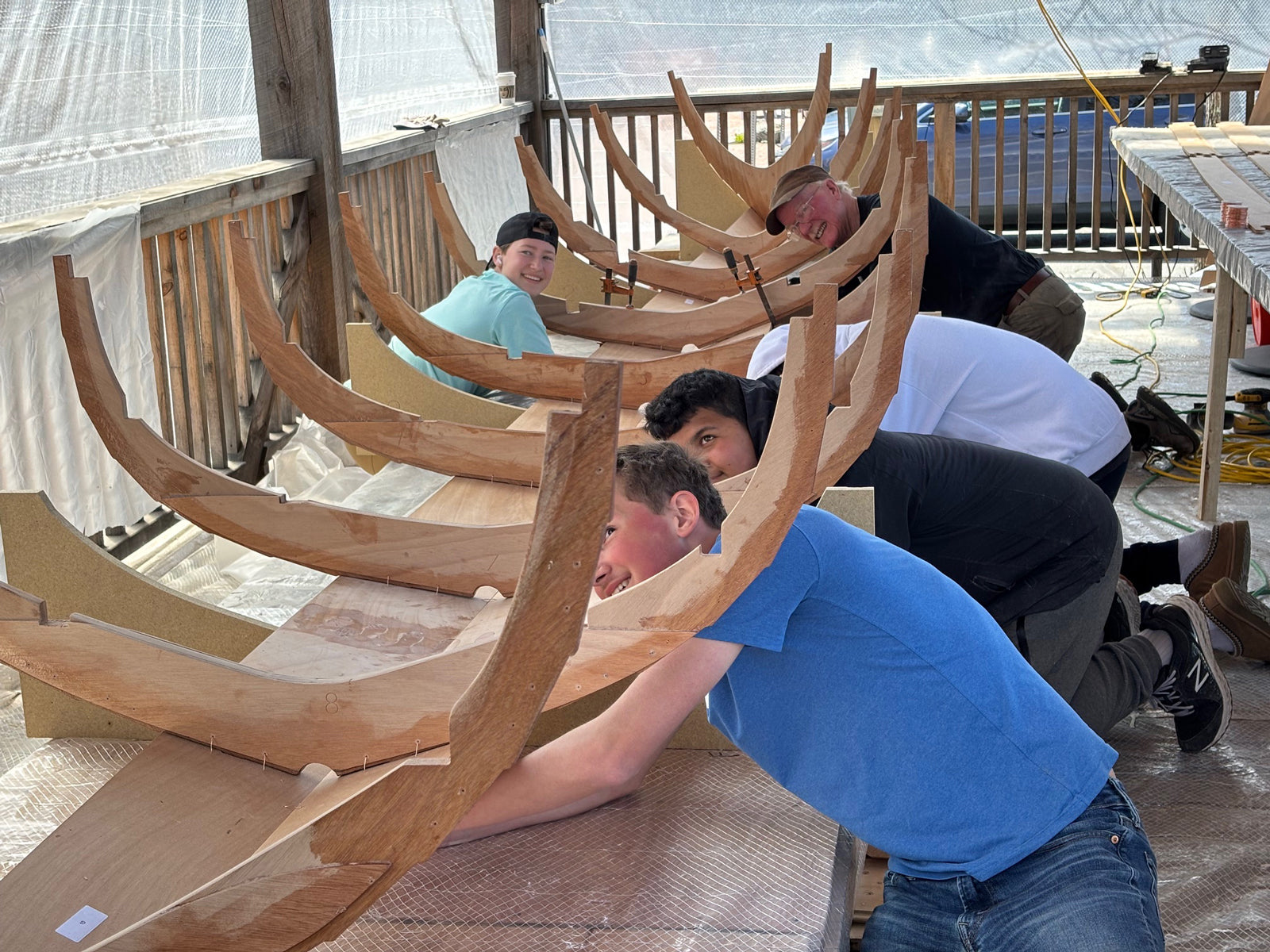
Volunteers in Freeport, Maine stitching up a Whitby Pilot Gig.
Four cradles keep the Whitby Pilot Gig assembly aligned and at a convenient working height.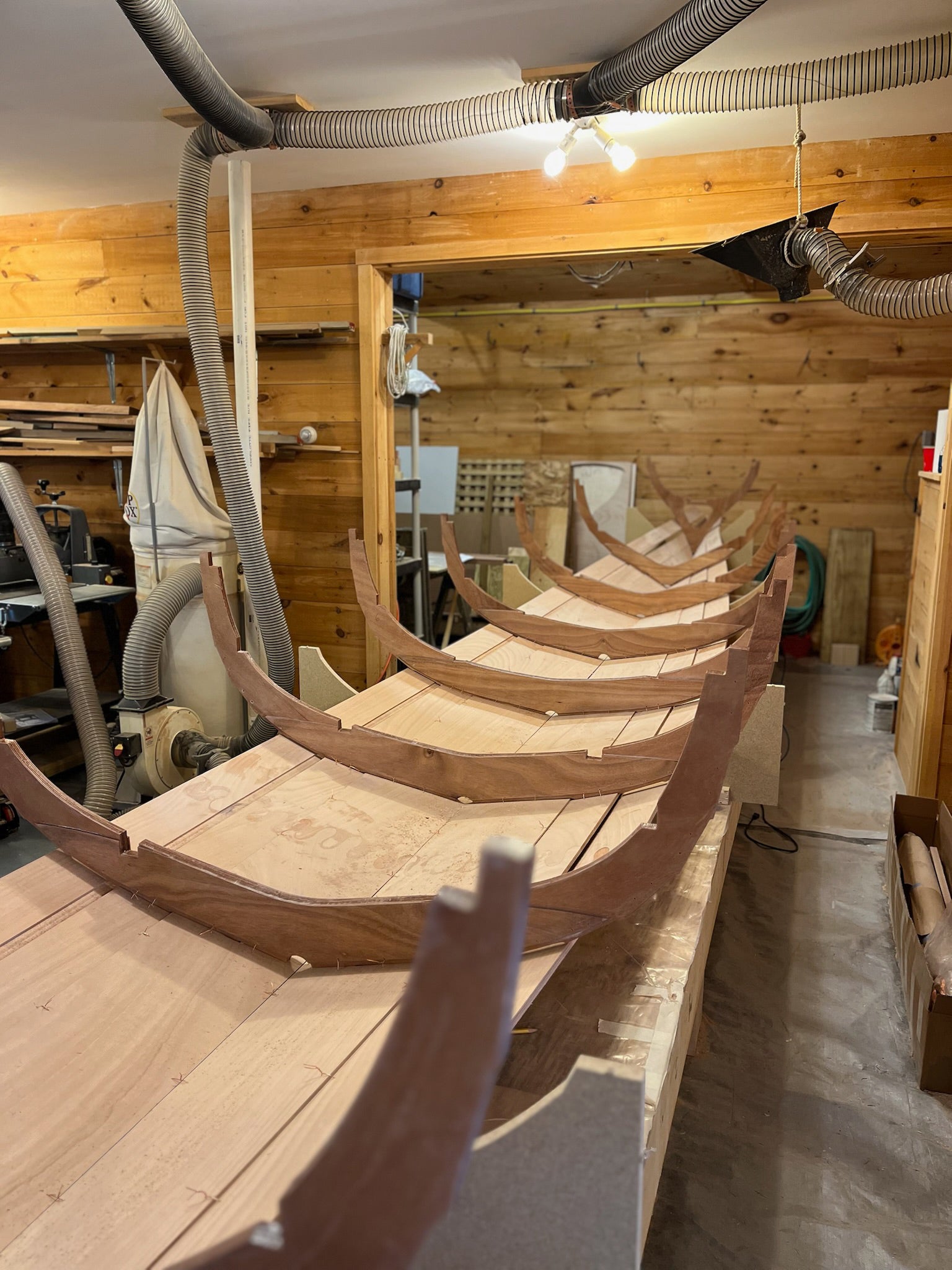
No traditional mold is required to build the Whitby Pilot Gig stitch-and-glue style. Once the CNC-cut planks are glued to length and the frames assembled, the hull is stitched together. Tabs in the frames drop into CNC-cut slots in the planking.
 The interior receives several coats of epoxy to seal the okoume marine plywood. The only fiberglass in the Whitby Pilot Gig is on the lower four strakes, to handle wear from abrasion and rocky beaches.
A CLC Whitby Pilot Gig racing in Belfast, Maine in 2023. One of three identical CLC gigs in that race. Fleets are growing.


