
The Guider (Watercraft Magazine, Issue #136)
camp cruiser, raid boat, sailing dinghyBy John C. Harris
May, 2019
"Raid Boats," a traditional type of small craft propelled by sail and oar and used in point-to-point races and rallies, first gained popularity in Europe in the 1980's and 1990's. They're really catching on in the US. A version of this article was first published in the British magazine, Watercraft, in 2019.
Scroll down for lots of sailing photos. The Guider's web page is here.
May, 2019
"Raid Boats," a traditional type of small craft propelled by sail and oar and used in point-to-point races and rallies, first gained popularity in Europe in the 1980's and 1990's. They're really catching on in the US. A version of this article was first published in the British magazine, Watercraft, in 2019.
Scroll down for lots of sailing photos. The Guider's web page is here.
H indsight is great fun. One of my favorite games is to redraw an old boat design of mine, pretending that I knew then everything that I know now. It makes me feel like a genius, gifted with piercing insight. In other words, everything that I am not. In 2008, John Guider asked if a little double-ender of mine, the Skerry, would be suitable for a very long camp-cruising voyage. No, I did not think an open boat lacking watertight stowage would be suitable. Also, John’s time and budget were tight and he'd never built a boat before. There were clear signals that I should pass on the project. But something about Guider's determination held my interest. I sketched a decked-in version of the Skerry that fit his budget and skill level, a design later to be known as the Skerry Raid.
indsight is great fun. One of my favorite games is to redraw an old boat design of mine, pretending that I knew then everything that I know now. It makes me feel like a genius, gifted with piercing insight. In other words, everything that I am not. In 2008, John Guider asked if a little double-ender of mine, the Skerry, would be suitable for a very long camp-cruising voyage. No, I did not think an open boat lacking watertight stowage would be suitable. Also, John’s time and budget were tight and he'd never built a boat before. There were clear signals that I should pass on the project. But something about Guider's determination held my interest. I sketched a decked-in version of the Skerry that fit his budget and skill level, a design later to be known as the Skerry Raid.
John Guider built the boat and launched it on his voyage before the paint was dry. He rowed and sailed from Nashville, Tennessee, down the Mississippi, across the Gulf of Mexico, around the peninsula of Florida, up the east coast to New York, then through rivers, canals, and lakes until he arrived back in Nashville. ‘The Great Loop,’ as North American sailors call it, amounts to some 6,500 sea miles (12,000km). It was an epic small boat adventure. But while John came to love his decked-in Skerry, praising its handiness and sea-keeping qualities, I don't believe it was the best boat for his trip. In spite of the addition of decking, bulkheads, and flotation, it was still a mess when swamped. The layout precluded sleeping aboard, a real hassle with nearly all of the waterfront in the US privately owned. John had plenty of scares and so did I, as the designer of this cockleshell. Throughout his Great Loop and during several ambitious trips he made subsequently, I kept wishing for a do-over.
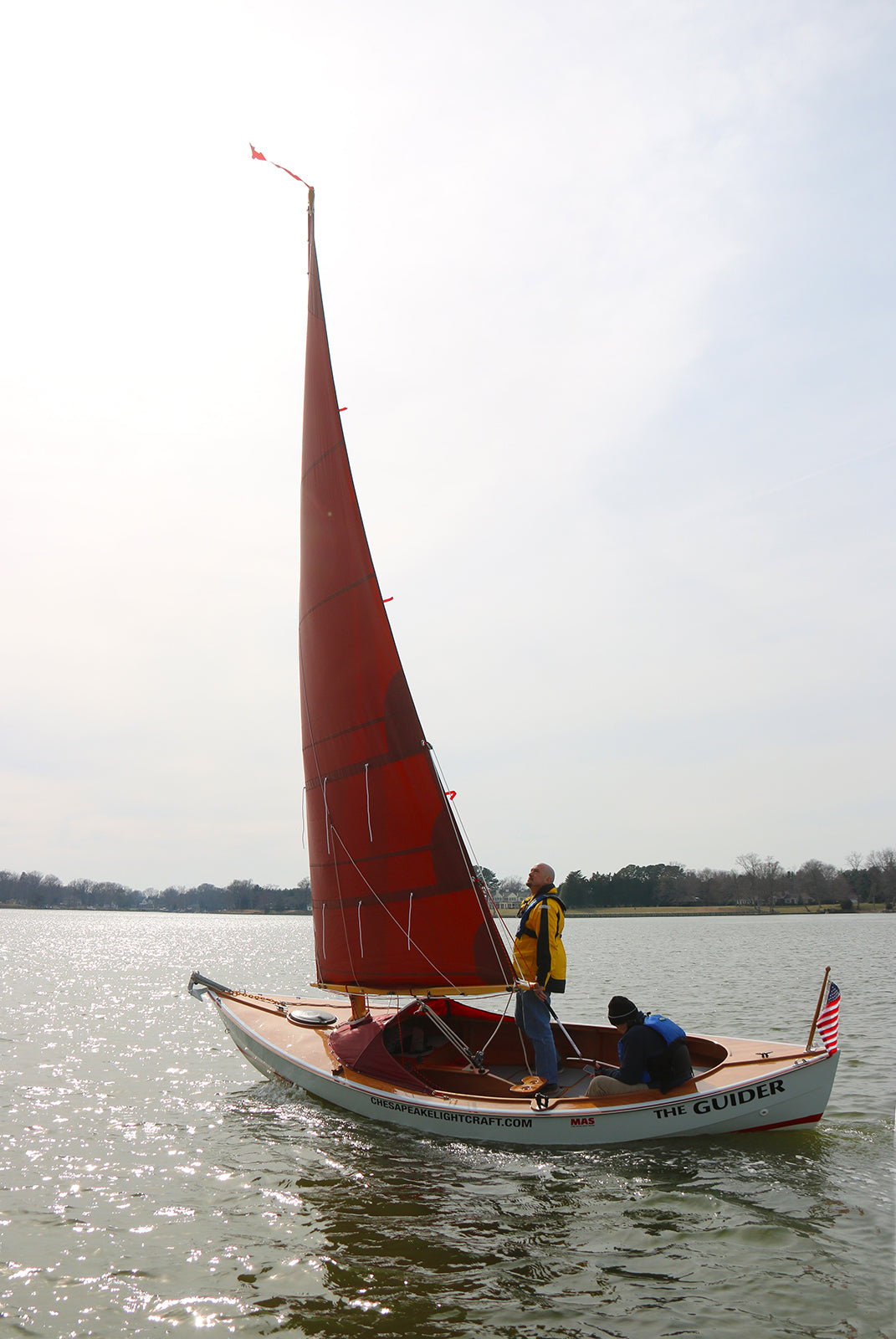
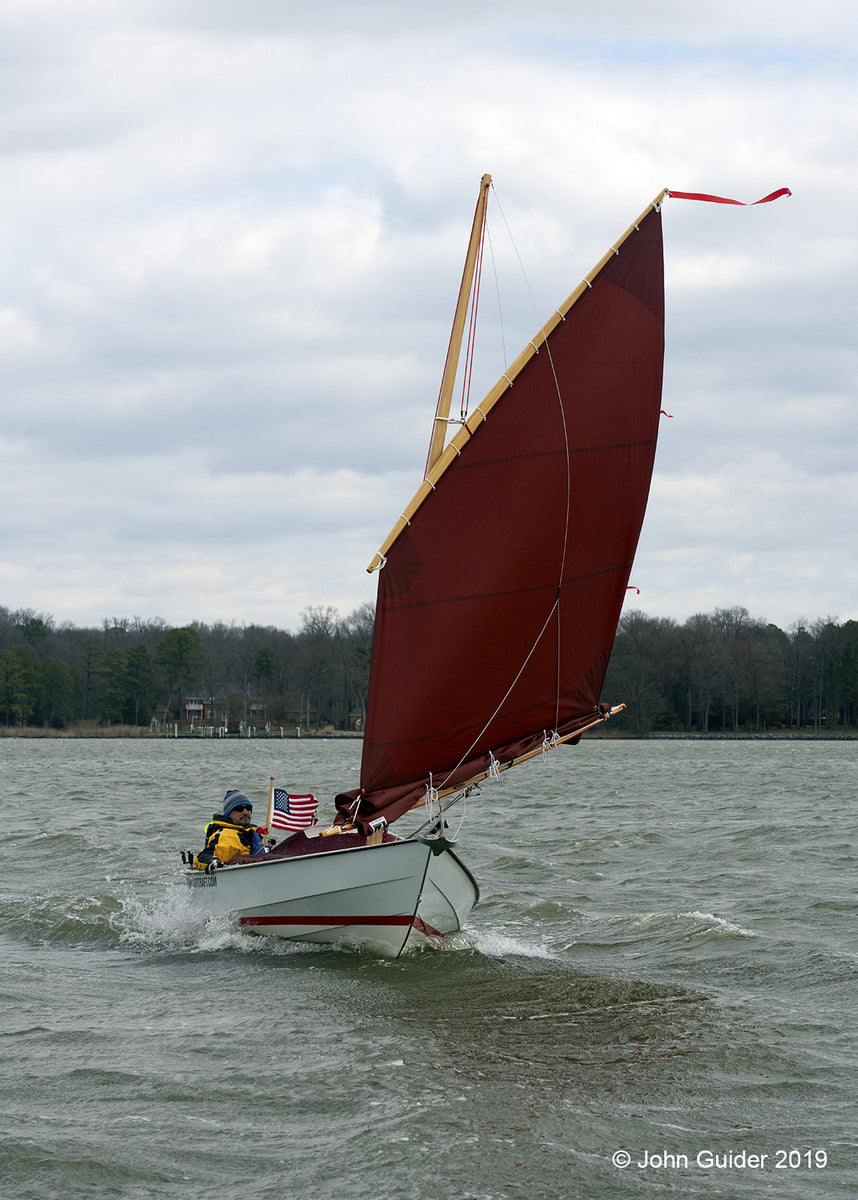
One voyage on John’s itinerary was the Race to Alaska. He actually started the 2017 edition in his Skerry Raid, stopping only when felled by bronchitis. When he got back to Nashville I suggested that perhaps it was time for a larger, more sophisticated dinghy. The race track from Port Townsend, Washington, to Ketchikan, Alaska, is always cold and can be frightfully rough. Here was my chance for another try at the Skerry Raid. Starting with a clean sheet, I drew an 18'7" (5.66m) double-ender. This one has decking and a raised floor subdivided into 13 watertight compartments. The elliptical cockpit buttons up nicely beneath a boom tent, sleeping two large adults with ease. To keep the boat simple to handle, there's a single balanced lugsail of more than ample size. The boat needed to row extremely well, so she's quite fine-ended by sailing standards. She carries ballast so that John won't have to hike out, racing-dinghy-style, all of the time. Depending on how much ballast is shipped, the weight of the boat on the trailer is around 650 Ibs (295kg).
"Guider" seemed as good a name as any for a raid-style boat. Using CLC’s LapStitch™ scheme, we built and rigged the Guider here in Annapolis in just 22 working days, launching for trials on the Chesapeake in March 2019. The boat proved fast and lively, rowing easily and showing a truly startling turn of speed under sail. With a 1/4" (6mm) aluminum centerboard and a foil-shaped retractable rudder, the Guider is really slippery; there's just nothing underwater to stop her. Probing for faults on the first outing in 25-30 knots of wind, we managed an inadvertent and chaotic capsize. The Guider floated high without turtling and was quickly righted singlehanded and bailed. I was delighted by this demonstration of her easy recovery. I think John Guider was less thrilled; he was the one who got a late-winter full-immersion soaking, unpleasant even wearing a brand-new drysuit.
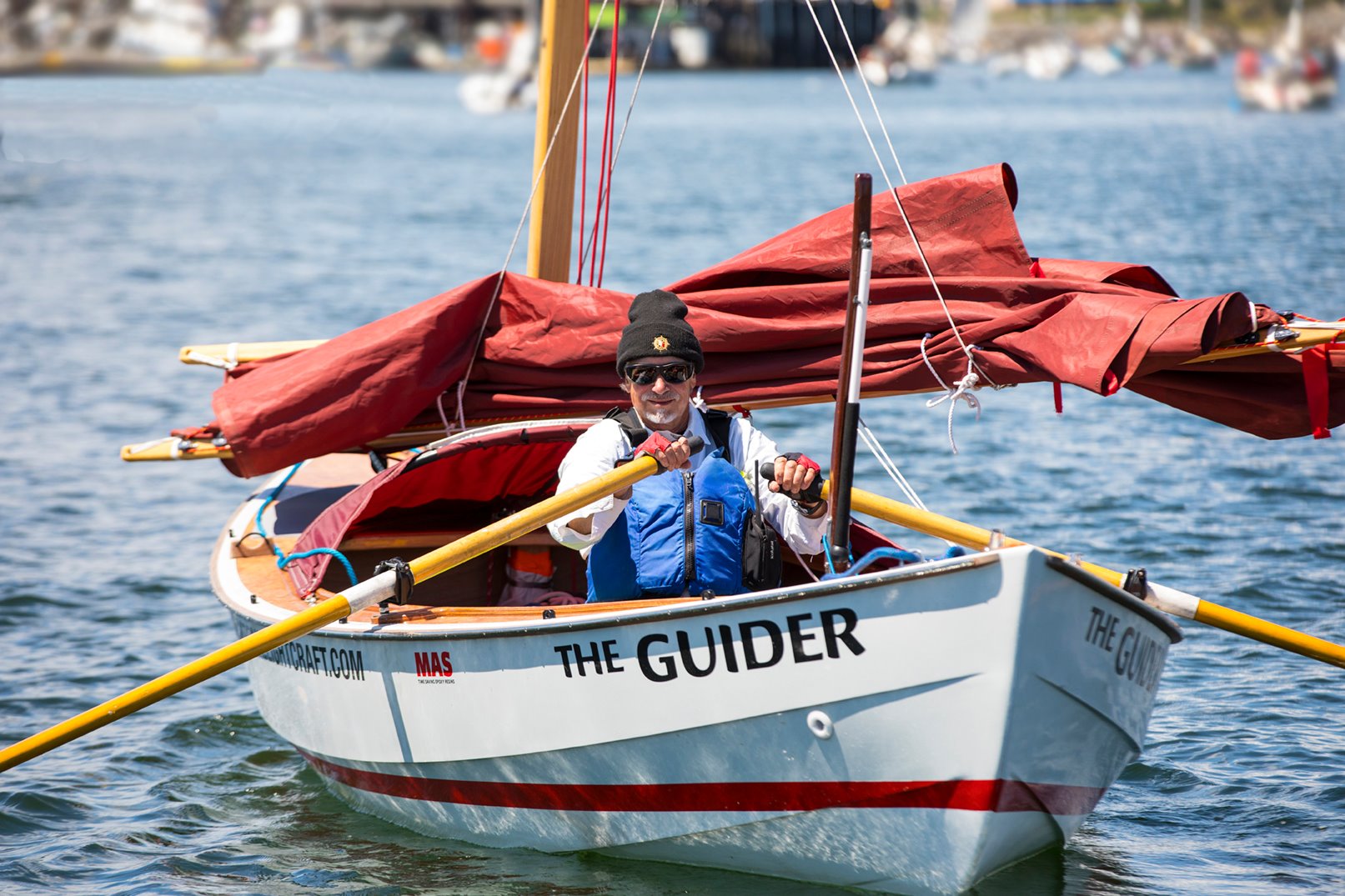
Compared to some big dinghies in this size and weight class, there's less primary stability. That's a function of the relatively narrow waterline and fine ends, a compromise to permit easy rowing. She stiffens up nicely before the rail touches the water. Under sail, she ghosts along in calm conditions. The first reef comes in at around 12-13 knots, and the second at 16-17 knots. More because it will look nice than because I think the design needs it, there will probably be a yawl-rigged version. With 9'6" (2.9m) oars, which stow out of the way on deck, we've found that the Guider can be rowed all day when the wind dies.
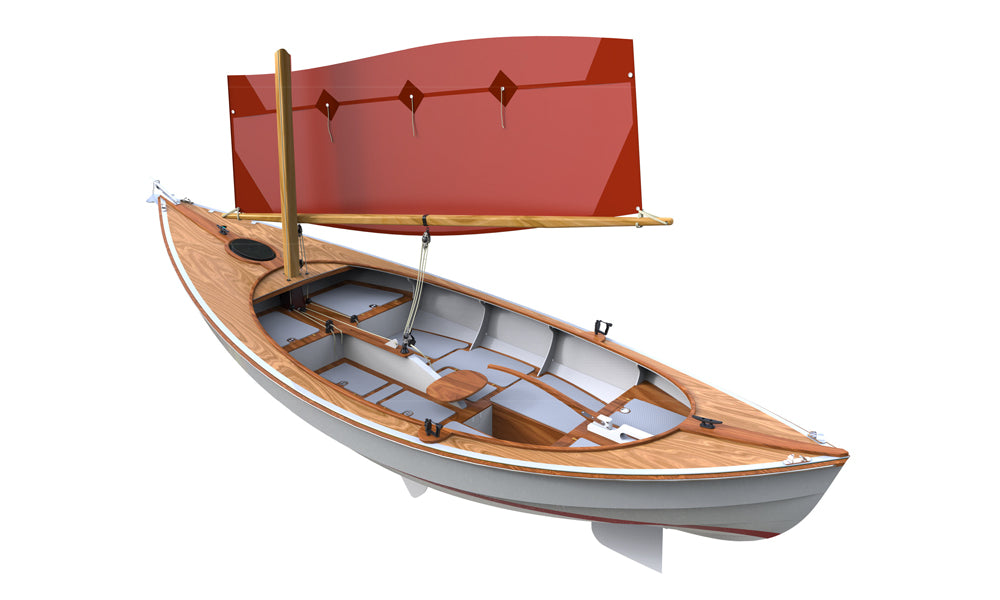
One feature which elicits comment is the ‘trunk rudder.’ The rudder is dropped through the bottom of the hull like a daggerboard. The main reason I chose this design was to avoid the hassle and awkwardness of tending to the rudder while sprawled across the narrow stern deck, immersed to the elbows. Instead, the rudder’s right there in the cockpit within easy reach for retraction. Drawing only 20" (500mm), you won't be inconvenienced even while beaching. Retract the rudder halfway to create a fixed skeg for rowing. I think the uncluttered canoe stern is especially graceful.
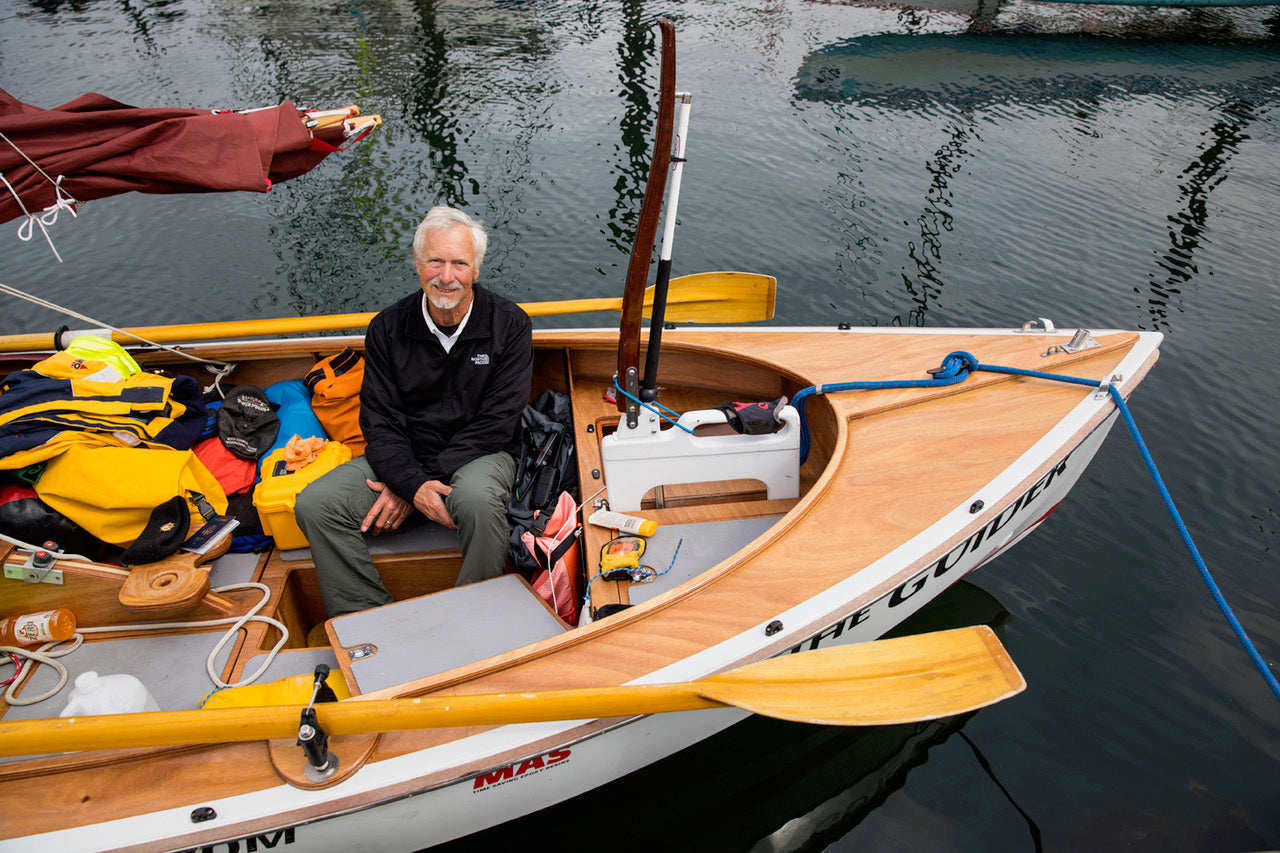
The Guider's deep sheer line is also eye-catching. I thought it matched the boat's vaguely Scandinavian style, but the main reason for it is to keep John Guider dry while clobbering his upwind way across the Strait of Juan de Fuca, combined with moderate freeboard amidships for the oarlocks. As I write this, John is camp-cruising on inland waters, to get a feel for sailing and living aboard before he heads to Alaska. We're still working to leak-proof the eight hatch covers, something that may require iteration. Other than that, not much to improve. I think you'd need to add a ballasted fin keel to make the boat any more foolproof as a dayboat. But not for beach cruising!
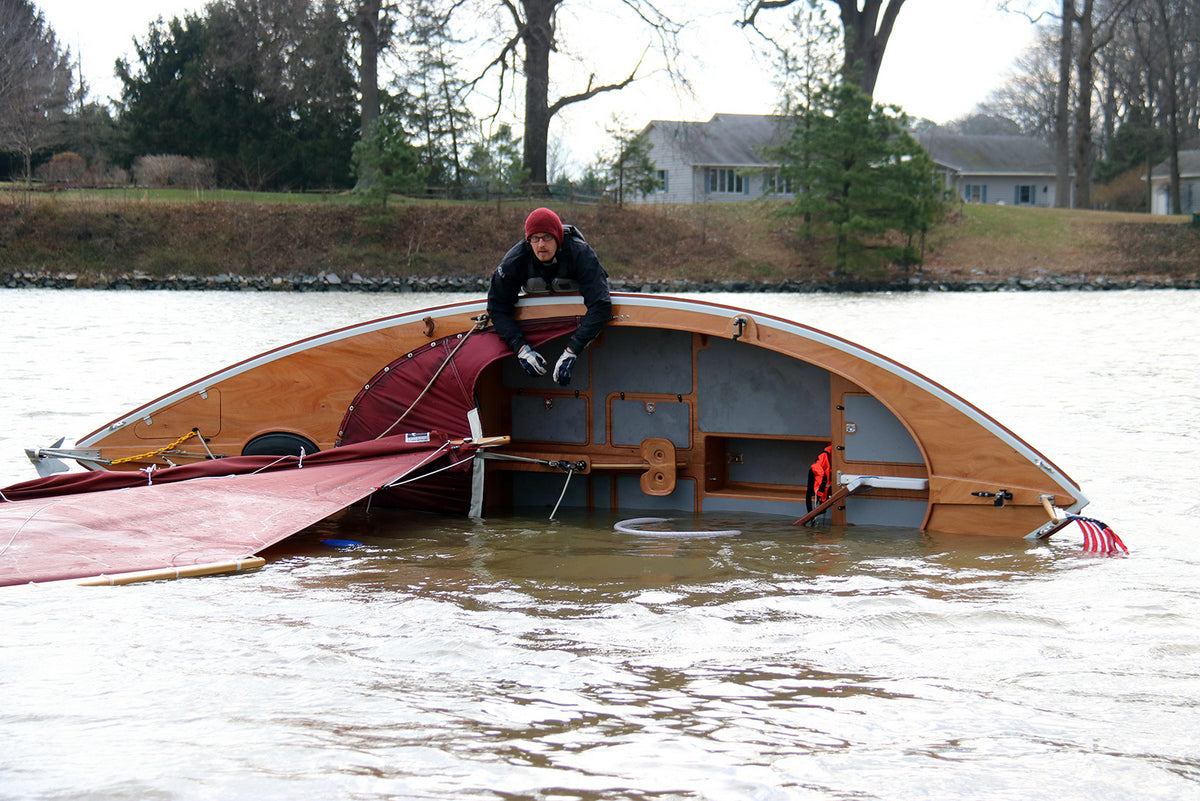
Capsize drill! The Guider floats high thanks to all of the sealed compartments, and with a hollow wooden mast is unlikely to "turtle."
Capsize drill! The Guider floats high thanks to all of the sealed compartments, and with a hollow wooden mast is unlikely to "turtle."
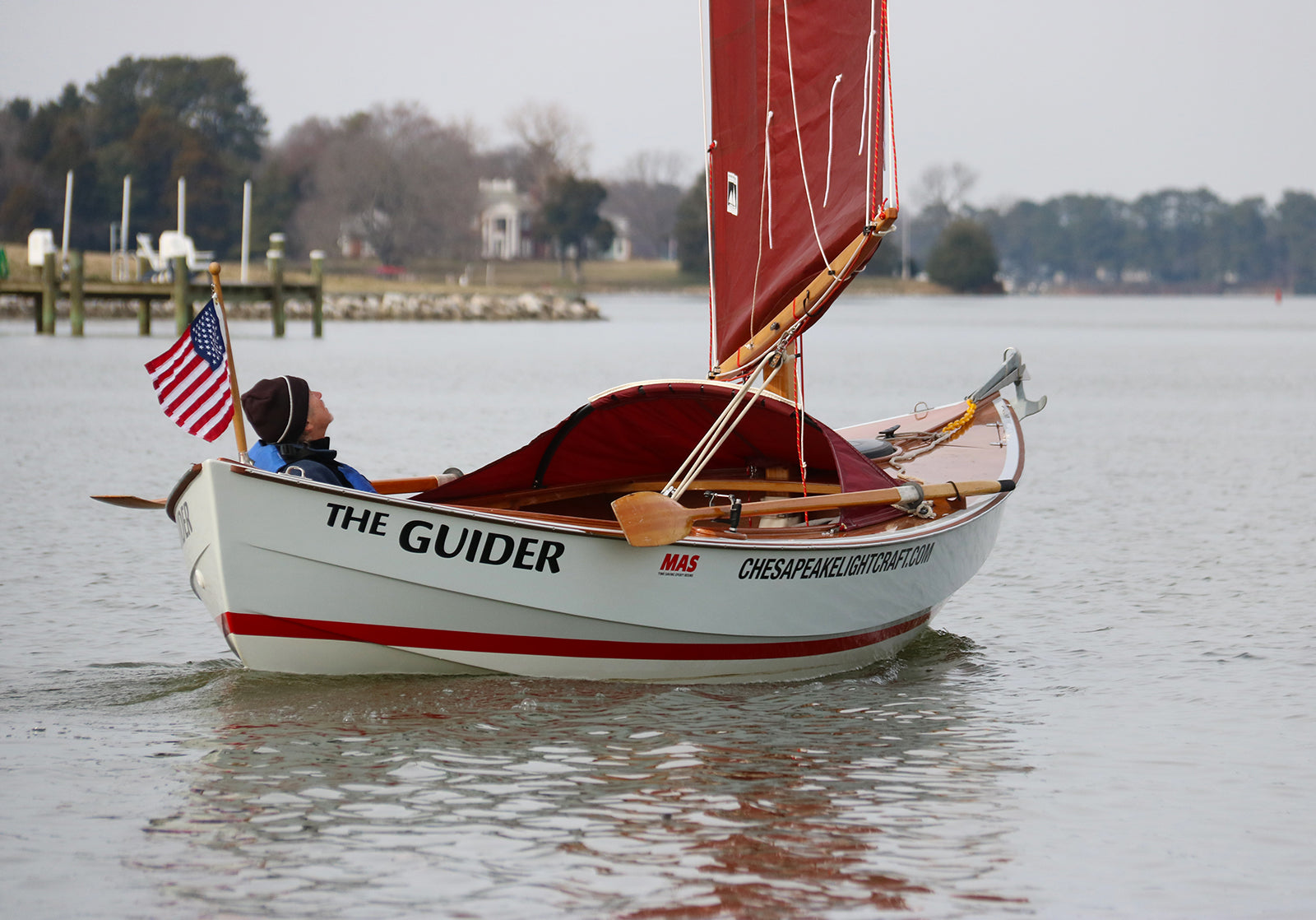
The oars stow out of the way on deck.


