2006/06 Sailing's Small Boat Issue - Perry on Design: Passagemaker
magazine appearancesPASSAGEMAKER DINGHY by Robert H. Perry (Perry on Design)

Why a pram? The world is full of prams. There is the Optimist, the El Toro, the Great Pelican and probably a Pelican; I’m not sure. In fact, the first boat I ever drew to my own design was a 12-foot pram. I “lofted” it on my living room floor using my mother’s knitting yard and pins to layout out the shape. It was a crude start but I needed to get a quick feel for the space available. I taught my two sons to sail in an El Toro pram, and Optimist prams account for the world’s largest one-design fleet. Prams with their truncated stems offer a lot of boat for a given LOA. I like to think of prams as another flavor of “double-ender.”
One of the benefits of this stubby and boxy bow is that you can board a pram from the bow without too much risk of turning it over. Try that with a conventionally bowed dinghy. Put your bathing suit on first though. The full bow of the pram has far more buoyancy than a pointy bow. For the same reasons I suppose if you wanted to get technical you could say the pram hull form has a longer sailing length for its LOA than a pointed bow hull form, but I’m not sure we are talking tenths of a knot when we discuss prams.
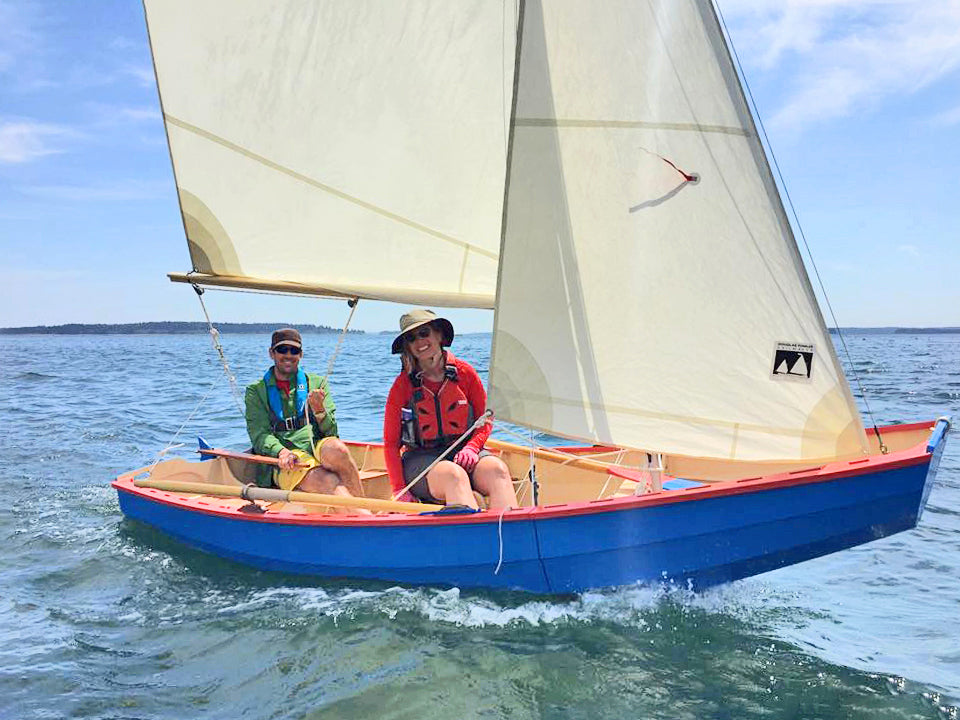
The Passagemaker has a flat bottom and a broad transom and quite a bit of bow overhang. This keeps the “front door” out of the water in a chop and provides a convenient place to tack the small jib. The finished boat weighs 90 pounds. The lines of this hull are accentuated by the lapstrake planking. I have always loved lapstrake boats, from Thompson runabouts to Folkboats. Lapped planking really emphasizes the lines of the boat. The daggerboard is modest in size and the rudder is a large kick-up type.
The Passagemaker kit features okume plywood planking and structural pieces. All come pre-cut in the kit. The planking is joined with the patented LapStitch™ method for a stitch-and-glue joint. The trim is mahogany. The brochure I have says, “There are no tricky steps, and no special tools are needed.”
You can put a four-horsepower outboard on the Passagemaker. It can carry a payload of 650 pounds. You can row it or sail it. The sailing rig is an option to the basic kit. The rig is a sliding gunter-type and you don’t see many of those anymore but it makes for a rig that can be easily broken down into short pieces to make stowage easy. The mast steps right on top of the double bulkhead where the Passagemaker comes apart.
I like just about everything about this design. I’m not wild about the long overhanging pram bow but I suspect that geometry may have something to do with the nesting requirement for stowage. It’s a shippy looking little pram that would be a great way to introduce your kids to boatbuilding.


