


Candlefish 18
- Skill Level Advanced
- Estimated Build Time 300 Hours
Build this boat if...
-

Classic Appeal
-

For Woodcrafters
-

Versatile


Builders also looked at...

We Can Help You Build This Boat
We offer classes for many of the boats we sell. For boats, such as this one, we can offer private classes upon request. Some customers also ask us to build the boat for them.Specifications
Performance
Stability
Speed
Cockpit Room
Payload
Ease of Construction
Overview
The Candlefish 18 is largest boat in the Candlefish lineup. Her hallmark is simplicity and utility, with a dash of performance. This a hull that works very well as the foundation of a number of Devlin designs including the Pelicano series. In this application it combines the flexibility of an open boat with the seaworthiness of a relatively tall hull. Sam has worked in large and flexible seating over the top of a huge amount of dry storage with even more storage in the bow. There is plenty of room for reserve buoyancy that, even in an unsinkable design, adds the peace of mind that comes from knowing the boat will float, level and stable, even when full of water. If the smaller Candlefish boats are waterborne pickup trucks, the Candlefish 18 is the moving van.
Candlefish 18 Design Notes
With the success of our little Candlefish 13 and her slightly larger sister, the Candlefish 16, I felt the need to be able to offer another larger version based on the hull of our Pelicano 18 but with the simple features and usability of the Candlefish design. If you are unfamiliar with the Candlefish type, I would like to run thru a quick description of the features of her and why she might work well into your own boating dreams.
All the Candlefish designs are tiller steered outboard boats that are built with the Stitch and Glue Construction method, a building method that I have been a staunch proponent of for all my 37 plus years of designing and building boats. These boats are open gunwale boats and by that I mean that the sheer rails of the boat are the sole extent of the protection from getting water into the boat itself so there are no side decks or other structures that might help to eliminate waves from slopping into the boat itself. So to help counter that small deficiency, I designed a relatively high freeboard into her hull or to put this more simply, the sides of the boat are high enough to help keep the occupants inside the boat and to help keep the water out of the boat.
For seating back in the stern, there are port and starboard side seats. These are both over 7 feet long and almost 22 inches wide each. When tiller steering her, you can choose either side to sit on and reaching over to the tiller of the outboard, it’s easy to face forward at an angle and keep your eye out for obstructions in the water. This type of side seating also helps to keep other passengers from impeding the skipper’s ability to operate the boat.
You will see from the drawings that forward of the long side seats in the stern of the cockpit, there is a seat or structure that extends from one side of the boat to the other at the same height as the stern seats and extends forward over almost 44 inches. Potted in the middle of the aft side of this deck structure (let’s call this the bridgedeck) is a hinged hatch that measures 24 inches fore and aft and 34 inches wide. If you unlatch and hinge up this hatch, it opens up the whole underside of the bridgedeck structure and exposes a neat cargo hold that can gobble up whole loads of fuel tanks, safety equipment, dry camping or survival gear and anything else you can dream up. All this is kept organized and out of the way of the occupants of the boat and most importantly, this gear storage area is all dry without rain or anything else getting into its stowed items. The other advantage of the bridgedeck is that passengers can sit at its forward edge with their feet on the forward cockpit floorboard and with some simple folding padded seat cushions, they have dry, comfortable, forward facing seats and they stay out of the helmsman’s way while working the tiller outboard at the stern of the boat.
Up forward in the bow of the boat is a stowage locker that comes almost up to the deck edge of the Candlefish 18. This bow deck extends aft from the stem of the boat almost 44 inches and is the full width of the bow. The height at the aft end is 4 ½ inches below the sheer of the boat, but up forward up against the stem, it is almost 12 inches deep. This deck has scuppers in the two aft edges of it that drain any water overboard and an anchor, anchor rode, spare dock lines, fenders or a cornucopia of other items can be stowed on this deck area safe and secure. Below that bow deck is a stowage locker that holds amongst other items, one of the neatest features of the Candlefish 18, the forward-most floatation component for her.
Under the bow deck area and in the stern of the boat on both sides of the cockpit below the stern seats are housed a total additional buoyancy of 480 lbs. Keep in mind our hull is built of epoxy sealed wood and by itself would not sink in any circumstance, but that outboard on the stern and some other heavy non-floating type gear that might be aboard dictate the inclusion of enough added floatation to keep the boat upright and level floating even if completely full of water. One of my favorite methods of providing this additional buoyancy is to use the simple and inexpensive type II life jackets. To make up that buoyancy requirement, we would need 24 individual life jackets. You can easily buy these on sale at your local marine supplier and even with a list price of $47.77 per (4) pack, you would have a total expenditure of $286.62 for all the additional floatation necessary to keep your boat positively buoyant in any weather conditions you might encounter. If you buy them on sale, you might get by with only spending just around $200 dollars for all the safety factor and peace of mind that an unsinkable boat provides.
The two ¾ inch marine plywood cockpit decks are set at a level of 2 inches above the loaded waterline of the boat. This allows you to keep the cockpit drain plug out of the boat if she is set up on a mooring in addition to keeping any rain water that might come aboard to be flushed out just about as quickly as it comes aboard. There are two drain pipes that connect up the bow cockpit deck to the stern cockpit deck so any bilge water can easily flush from forward to aft and overboard. When you reach the mooring, the drain plug can be replaced to its position in the stern of the boat and you can load her to your heart’s content, confident in the fact that any bilge water will be able to be flushed back while under power.
The Candlefish 18 is an almost perfect size for explorations with a good, light dry weight, she’s easy to launch by hand off the beach and she has performance enough to satisfy the tyro in all of us. This is really just a pointed bow open skiff with an outboard on the stern but with some very interesting twists to it. For power, I picked an outboard motor, tiller steered, using anything from 40-70 hp depending on how fast one wants to run and how much load is expected to be carried. Just like her smaller sisters, the Candlefish 18 is the sea-going equivalent of a pickup truck, capable of carrying a decent load and handling many of the chores you might encounter in your life on the water.
The Candlefish’s hull is planked up from good marine plywood 7ply, 12mm mahogany of the BS-1088 grade. She is built Stitch and Glue style over 4 full bulkheads and her transom and she is strong and stiff. With a hull sheathing of fiberglass cloth set in epoxy and with her keel and bilge keels, she keeps her hull off the bottom when beaching and is strong and easy to maintain.

LOA: 18′ 5" -- 5.6388m
Beam: 7’ 5.375" -- 2.270125m
Draft: 7.5″ -- 2.286m
Max HP: 70-hp
Epoxy required to build the Candlefish 18:
- Three #3 Epoxy Kits & One #4 Epoxy Kit are required to build this boat.
Epoxy required by item:
- Resin 7 gal
- Slow Hardener 3.5 gal
- Wood flour, cell-o-fil fillers, & pumps
NOTE: Boat plans will need to be purchased from Devlin Builders, separately for all kit variations.

Line Drawings


Videos

A Legacy of Craftsmanship: Devlin Wooden Boat Building
Frequently Asked Questions
We Can Help You Build This Boat
We offer classes for many of the boats we sell. For boats, such as this one, we can offer private classes upon request. Some customers also ask us to build the boat for them.
View Classes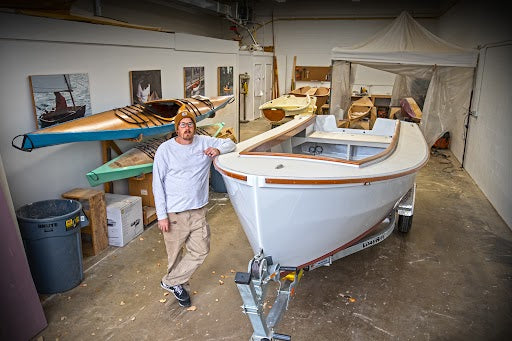
We Also Recommend


Need Help Building it?
We’re here to help with any questions you might have during the build process.


