Which Small Boat Sailing Rig for Me?
Sails, the Sticks That Hold Them Up, and the Ropes and Strings That Control Them
Being an AI-free look at the things that make sailboats go...
By John C. Harris
March 2026
We get a lot of questions about sailing rigs. CLC's fleet of designs includes at least six types of sails, mixed and remixed into a dozen different layouts. Why do you choose one rig over another? The pros and cons could fill several books.

The subject DOES fill several books. And head and shoulders above all of them is 100 Small Boat Rigs, by Philip C. Bolger. It's been out of print for a while, but you can find it in the library and at used bookstores. I think it's the best book about small sailboats, in the English language, of the last 100 years. (If you doubt the esteem in which the book is held, note that used copies are trading for between $70 and $350 online.)
In this article I'm going to run through some common small boat rigs and explain why one set of sails and sticks might be chosen over another. Describing the sails, the spars that hold them up, and the organization and control of the sails and the spars requires a cloud of obscure terminology. Eyes glaze over. Distinctions blur. Pedantic sailor types get their blood pressure up.
Here's a basic glossary. Sailing nerds may skip ahead.
"The Rig": As a noun, the "rig" is the configuration of sails on a boat, IE, the sails and everything that holds them up and controls them. As a verb, to "rig" a boat means to set up the sails and spars, and ready them for action.
Rigging: Nowadays "rigging" refers to all of the ropes (and, sometimes, wires) associated with the boat's spars and sails.
Spars: A catch-all term for all of the sticks and poles, regardless of their configuration. Masts, booms, yards, sprits, gaffs, bowsprits, sternsprits, reaching struts, and topmasts are all "spars."
Mast: The vertical thingie, the largest of the spars.
Boom: A spar attached to the bottom of a sail.
Yard: A spar attached to the top of a sail, unless it's a "gaff sail," in which case the spar attached to the top of the sail is...a "gaff." (I warned you that this was esoteric.)
Sprit: A spar that isn't attached to the top or bottom of a sail, but instead crosses the sail at an angle. Except when it's a bowsprit or sternsprit, which is something else. Often, and irritatingly, misspelled and mispronounced "spirit."
Sheet: The rope that is the primary means of control for a given sail. You can have mainsheets, jib sheets, mizzen sheets, spinnaker sheets, gollywobbler sheets, spanker sheets, and so on.
Lines: Sailors prefer to use the word "lines" instead of "ropes" when referring to sail controls. EG: "Lines of different diameters and colors are used for sheets, downhauls, vangs, and halyards."
Halyard: The rope that "hauls the yard" up the mast, now the universal term for the rope that hoists any kind of sail to the top of the mast.
Reef: The act of making a sail smaller when the wind is blowing too hard for the full sail. As a noun, refers to all of the hardware and rigging involved in reefing. "Reef points" on the sail, "reefing lines" for the rigging, for example.
Mainsail: Just what it says. On a boat that has more than one sail, it's usually the biggest, most important sail.
Mizzen: In boats with a big sail up front and a smaller sail in back, the sail in back is called the mizzen.
Jib: A triangular sail set forward of the mainsail. Among other things, jibs act like "leading edge slats" for the mainsail, and even small jibs will add a lot to the mainsail's power. Racing sailors are fond of jibs; casual sailors, less so.
Here are a bunch of popular rigs. I'll try to identify the major ups and downs. Lug rigs are ascendant at the moment, and when I started this post a week ago, I barfed a thousand words about lugs onto the page. I've moderated that, and put my thoughts on lugs at the end of the article.

The CLC Skerry, with a sprit rig.
Rig Type:
Sprit
In a Nutshell:
A simple sail, powerful for its size, that's easy to set and take down. The mast, boom, and sprit can be short and don't require much engineering.
What are the advantages?
Sprit rigs go back at least 500 years in Europe but seem to be in decline among pleasure craft. 25 years ago, I chose a sprit rig for the Skerry because the spars are simple to build—square in section, with no tapering—and fit inside the boat for transport. It's also a common small boat rig in Scandinavia, and the Skerry has a distinctive Nordic flavor and handling qualities.
In the Skerry, the sprit sail is laced permanently to the mast and to the boom. To stow the sail, you remove the sprit—the diagonal spar in the drawing above—fold the boom up against the mast, and bundle up the sail. Setting the sail requires removing a few lashings, plunking the mast into its step, unfolding the boom, and rigging the sprit. This can be done in about the time it takes to read this paragraph.
What are the disadvantages?
With the luff of the sail laced to the mast, you get some turbulence across the sail that diminishes its power when sailing upwind. Having the sail laced permanently to the mast and boom means it's hard to reef the sail, and in a boat as light as the Skerry you really need to do your rigging and de-rigging on the beach. The Skerry's balanced lug option is more popular.

The sprit-rigged Skerry sailing fast and flat on a windy day.

The Jimmy Skiff's Leg o' Mutton mainsail.
Rig Type:
Leg o' Mutton
In a Nutshell:
A triangular or "jib-headed" sail shape. Offers some of the power and efficiency of modern racing dinghy mainsails, but it's easier to control, and simpler and cheaper to rig.
What are the advantages?
"Leg o' mutton" sails are typically tall, with tapered, bendy masts, no "roach" in the sail and thus no sail battens, and they have a "sprit boom" that crosses the lower section of the sail diagonally. The draft of the sail is adjusted with a "snotter," everyone's favorite nautical term. This is a pretty good choice when you want a tall rig, for power in light winds, as well as controllability in stronger winds. 99% of the time these rigs have flexible masts, and the mast flex can be tuned so that the sail automatically spills air in gusty conditions.
Separate from the advantages of the bendy mast, this sail shape and its specific rigging geometry are really effective at preventing the sail's airfoil shape from twisting the wrong way when under load in gusty winds. While this may be difficult to visualize, the key here is that too much sail twist, while reaching and running in heavy air, can cause a lightweight boat like the Jimmy Skiff to capsize if the skipper isn't attentive. The same sail with a boom laced to the bottom of the sail—a much more common approach these days—requires a piece of rigging called a "boom vang" to mitigate the twisting problem. Boom vang hardware for a sail the size of the Jimmy Skiff's can easily run you $250, and it only works if you know when and why to use it and remember to do so. The boom for boom-vang-equipped yachts has to be heavier and more strongly engineered than the leg o' mutton's light, simple sprit boom.
What are the disadvantages?
These sails are usually pretty tall, which means you've got to build a tall mast. (The 13'2" Jimmy Skiff II's 68-square-foot sail requires a mast over 19 feet tall.) And that mast needs to be smoothly tapered from max diameter at the deck, to the diameter of a broom stick at the top. This bit of woodworking might make some first-timers uneasy.
Leg o' mutton sails are often simply laced to the mast, which makes it hard to reef, or to douse the rig while out on the water.
I wish someone would devise a better name than "leg o' mutton." Apparently, the leg of an aged sheep, processed into food, is triangular in shape. (I would not know.) Phil Bolger tried to get everybody to refer to sails of this shape as "jib-headed," a practice I have adopted, but which has not caught on.

A great picture of a leg o' mutton sail functioning exactly as intended. In a strong breeze, this Jimmy Skiff II is fully powered-up, planing on a beam reach. Thanks to a healthy amount of tension on the snotter, there's just about the perfect amount of draft in the sail, and no twist.

CLC Outrigger Junior with its Oceanic lateen sail.
Rig Type:
Lateen
In a Nutshell:
The lateen rig offers a lot of horsepower for its height, and it can be controlled with relatively simple spars and controls. For pedantic types, we're really talking about an Oceanic lateen, because in addition to the yard at the top of the sail, there's a boom on the foot of the sail. The lateens of ancient Europe and the Middle East never had booms.
What are the advantages?
The Sunfish, one of the most popular sailboats in the world, is probably the only modern lateen-rigged boat you've ever seen. Like the leg o' mutton and the balanced lug, the primary benefit is that it generates lots of thrust on all points of sail without the need for complicated sail controls. A halyard and a sheet and off you go. (Racers add a downhaul for more control over the sail shape...but millions of casual sailors haven't bothered.)
One of the goals of the CLC Outrigger Junior design was to achieve Hobie Cat performance (or better) with lumberyard materials. The Outrigger Junior is 12 feet wide and thus has enormous righting moment, allowing it to carry an enormous amount of sail. 165 square feet of it, which is 120% more than a Sunfish. Big sails and lots of righting moment result in big dynamic loads. Sailboats like the OJ that are capable of 15 knots usually resort to carbon fiber spars, or at minimum aluminum spars held up by stainless steel wire. If I was going to make it work with wooden spars and a short, sturdy, unstayed mast, an Oceanic lateen was the best and only choice. It was a nice symmetry because all fast multihulls are descended from the proas, outriggers, and catamarans of Oceania. Their "crab claw" rigs have exactly the same design brief: sail-carrying power for fast multihulls using low-modulus wooden spars.
What are the disadvantages?
Oh, there are lots. A lateen sail's mast can be short, but the boom and yard are going to be long. The boom and yard for a Sunfish, in fact, are longer than the Sunfish. The 15-foot Outrigger Junior's boom and yard are 20 feet long. They've got to be strong and light, but they also must bend in a predictable fashion so that the sail maintains its three-dimensional shape. The mast, boom, and yard are simpler and cheaper than almost anything you'll ever find on a 15-knot sailboat, but it's a lot of spar building, all the same. Aluminum tubes are probably better. Carbon fiber tubes, better still...
Big lateen sails are tricky. Down at Sunfish size, lateen sails are reliable, inexpensive, and low-drama. But so are balanced lug sails—and the luggers are faster upwind.
The Outrigger Junior's enormous lateen sail is hard to fit into a photo. But you get a sense of the horsepower on tap. Not bad for an unstayed mast and two springy cypress yards. This is one of the early hulls; visibility to leeward wasn't great and a window was added to the sail in production versions.

CLC's Lake Union Swift, a bog-standard example of a modern sloop.
Rig Type:
Sloop
In a Nutshell:
A lightweight mast (usually aluminum), held up with shrouds (usually stainless steel wire). The triangular mainsail slides up and down the mast and has a boom at its foot. The triangular jib is usually a little smaller and slides up and down a wire led from the mast to the bow of the boat. You've seen ten million of them.
What are the advantages?
In short: when all the components of a sloop rig are working right, it's a fast and efficient way to move a sailboat. In knowledgeable (and energetic) hands, the sloop can be tuned and reconfigured almost infinitely, to suit any combination of wind and wave.
Two of the three edges of the mainsail are bounded by spars, making that sail easy to handle, if you remember to keep your head clear of the lethal boom. With the right pile of hardware, reefing the mainsail of a jib-headed sloop is easy.
The jib benefits aerodynamically from a clean, sharp leading edge. A correctly-trimmed overlapping jib smooths and accelerates the air on the lee side of the mainsail. The jib's ability to increase the power of the mainsail is so pronounced that a sloop feels dead when the jib is taken down.
A sloop with good sails, properly set up and trimmed, is incredibly good at sailing upwind. To do any better upwind requires a BIG jump in the hardware and technology. Wing masts; composite sails; "square-top" mainsails that are basically airplane wings set up on edge. (MORE efficient than airplane wings, really.)
What are the disadvantages?
Thanks to incredibly esoteric yacht-racing rules, jib-headed sloops became so popular and prevalent during the 20th century that other rig types seemed in danger of extinction. When I was a kid in the 1970's and 80's, it would not be unusual to go sailing on a busy summer weekend and every other sailboat on the water was a sloop with white Dacron sails. I guess it was a combination of fashion and commercial inertia. All of the hardware at the local marine chandlery was meant for sloops with aluminum masts. 25 years ago, I went to a big sailmaking firm to source lug sails and sprit sails for CLC's growing fleet...and their computer software could only draw triangular sails.
Which is too bad. Many cruising boats that defaulted to tall sloop rigs would have been easier to handle, sailed better, and cost less with more traditional rigs. Refinements such as full-length battens in the mainsail (allowing a shape more closely approaching the "airplane wing" ideal), and roller-furling jibs (for ultra-quick setting and stowing) have made sloops more efficient and user-friendly. But...modern sloops are really, really, really expensive!
When sloops are rigged, tuned, and trimmed correctly, they're fast. But the advantages only convey if you know HOW to rig, tune, and trim a sloop rig. And you have to be willing to pay for a lot of expensive hardware. The really fast, tricked-out sloops are time-consuming to rig at the launch ramp. The way I like to explain it is that if the race started on the water, a sloop will get around the course quicker. But if the race starts in the launch ramp parking lot, the balanced lug boat wins. Most people are better off with simpler rigs.

Sloop rig...modern racing dinghy style! All those strings snake through low-friction blocks under the decks, inside the mast and boom, and out to the ends of the boat. These controls allow the crew to make deliberate, subtle, adjustments to the shapes of the mainsail and jib, optimizing the sloop for wind strength, the point of sail, wave conditions, and even the weight of the crew. Anyone can tug on all those strings, just as anyone can pluck at a guitar, but it takes time and experience to actually play a tune!

CLC has a couple of sloops in the catalog, the largest of which is the 31-foot Pacific proa, "Madness." Madness has been clocked at 20 knots. With some care and economy, including rehabbing a reject carbon fiber mast meant for a racing catamaran, the rig and sails for mine cost about $20,000 in 2011. Six sister ships have been built to this design.
PocketShip, a gaff-rigged sloop. Shown here in racing trim, with a jackyard topsail, a larger mainsail, and a deep fixed-draft "racing" rudder.
Rig Type:
Gaff
In a Nutshell:
A gaff sail is trapezoidal and has a spar supporting the top of the sail called—wait for it—a gaff. Gaff rigs (with or without jibs) are a good way to spread a large amount of sail area on a relatively short mast, in turn requiring less rig tension and engineering compared to the usual sky-raking jib-headed sloop.
What are the advantages?
Gaff rigs were working boat rigs as long as there were working sailboats. Powerful, rugged, low-tech, everything a working sailor could want.
Gaff rigs were popular for cruising yachts up until the 1940's, at which point racing sailboat technology started defining sailboat design fashion, in place of practical considerations (and common sense). It became conventional wisdom that gaffers were slow, especially upwind.
Here's the thing: A well-designed, neatly-rigged, competently-sailed gaff sloop will sail upwind just as well as a conventional jib-headed sloop. Since the gaffer can spread more sail area per foot of mast height, as soon as sheets are eased, the high-strung jib-header might struggle to keep up.
And that's why I like gaff rigs. For a given mast height, they are powerful sails; the high-torque diesel engines of the sailing world.
What are the disadvantages?
With gaffers it isn't a case of "simple" versus "complex." It takes two halyards to hoist a gaff mainsail, for example, and just one to hoist a jib-headed mainsail. Because they're powerful and torquey, gaff rigs tend to be heavy, kind of the way diesel engines are heavier.
And while gaffers CAN sail as well as the cool kids, it doesn't happen automatically. To get the best out of them you need a good sailmaker, the peak halyard needs to be adjusted just so...the right amount of outhaul...the proper mainsheet lead...
Beware the well-sailed gaffer. Might alter your preconceptions.
At last we arrive at Lug Sails!

I've got an entire article about lug rigs HERE, which you should read. Below, I'll run through the various flavors of the lug rig. At the end I've appended some thoughts on LARGE lug sails, which have special considerations.
Here's why luggers have made a big comeback in the 21st century:
1. Lug sails are powerful and efficient without requiring a tall mast. They are cheaper and less complex to rig compared to other rigs, but perform well on all points, including upwind. It's a fact that a well-rigged and competently-skippered lugger will sail to windward a lot better than an indifferently-rigged and indifferently-skippered sloop.
2. Lugs are quick and easy to set up, take down, and reef. Lugs are connected to the mast only by a halyard and a downhaul, which means there is very little friction in the system as the sail goes up and down the mast. THAT, in turn, means that when you need to take down your lug sail, it will jolly-well come down RIGHT NOW, a safety feature in the event of a sudden squall.
3. The lugger's mast, boom, and yard are simple to design and build. In the smaller sizes (such as the CLC Skerry or Passagemaker), the spars require no tapering or shaping.
4. Balanced lug sails are "self-vanging." It's a complicated detail, which I'll summarize thus: When reaching or running, the unique geometry of a balanced lug sail limits the twist in the sail. In small boats, especially, this enhances stability and can prevent a capsize in strong winds.

The Eastport Nesting Pram's standing lug sail.
Rig Type:
Standing Lug
In a Nutshell:
A standing lug differs from a balance lug in that the tack—the forward, lower corner of the sail—is right at the mast. There's less sail forward of the mast to "balance" the sail.
What's the Advantage?
Standing lugs are pretty rare, because they lack that self-vanging feature I mentioned above. You find them in settings where a lug sail's simplicity and low center-of-effort are desirable, but there is an absence of space forward of the mast for a "balanced" section of the sail. In the little Eastport Pram, above, the mast needs to be right up in the eyes of the boat, and extending more sail forward of the mast would create balance problems.

"Standing lugs" show up often in the little yawls we all know and love. This is the Lighthouse Tender Peapod in its yawl configuration. To help keep the middle of the boat clear for the crew, and clear of the mainsail, a standing lug was the best option for the Peapod's mizzen sail.
Rig Type:
Balanced Lug
In a Nutshell:
Balanced lug sails are hoisted on one side of the mast, with a good percentage of the sail area projecting forward of the mast. (See the Peapod's mainsail, above.) With good halyard and downhaul tension, these sails are easy to control and yield high performance for the time and money.
What's the Advantage?
Even 25 years ago you didn't see many lug sails. Used to be, most small boats were given rigs derived from racing dinghies. In 2026, small boats based on traditional sailing craft are ascendant, and loads of them have balanced lugs. They don't require fancy spars or specialty hardware. (You can set these up with no hardware at all; surf around the web for ideas for homemade cleats, blocks, and sheaves.) These sails have a clean luff, hold their shape with a minimum of tuning, and provide more drive per square foot than anything this side of a grand prix racing dinghy.

This photo of a Skerry, hauling the mail, with a stock 62-square-foot balanced lug sail, is a great demonstration of the balanced lug's simplicity and power. There's a halyard, a downhaul, and a mainsheet. The sail is lashed to the boom and yard. Simple components, turning wind into boat speed.

Thoughts About BIG Lug Sails
I've spent a lot of column-inches here extolling balanced lug sails, and for boats in the 8- to 17-foot range they are a compelling choice. I don't think the balanced lug scales UP nicely. Luggers over 90 or 100 square feet are powerful, but to manage that power, the spars start getting heavy, and the rigging much more complex.
The CLC "Guider," a fast 18'7" cruising dinghy, needed hollow spars AND (for the purposes of the Race to Alaska) carbon fiber reinforcement. Like every other lug sail this size I've worked on, taming that sail was a real challenge. Even with great care in the design and construction of the spars, that sail is still a heavy lift, requiring a 2:1 purchase on the halyard. The downhaul—essential for controlling the draft and twist of a lug sail, even small ones—is an expensive 4:1 tackle on the Guider.
There's a lot more to think about. The Skerry's 62-square-foot lug sail just piles up in the boat when you uncleat the halyard and the sail comes down. You shove the bundle of sail and spars out of the way so that you can sit down and row. But the Guider's boom and yard are both eleven feet long. Even in an 18'7" boat with a big cockpit, there's no shoving those out of the way! If you let the halyard run, the sail and spars fall into the cockpit and might collapse the canvas dodger at the front of the cockpit. Rowing or operating the boat is impossible.
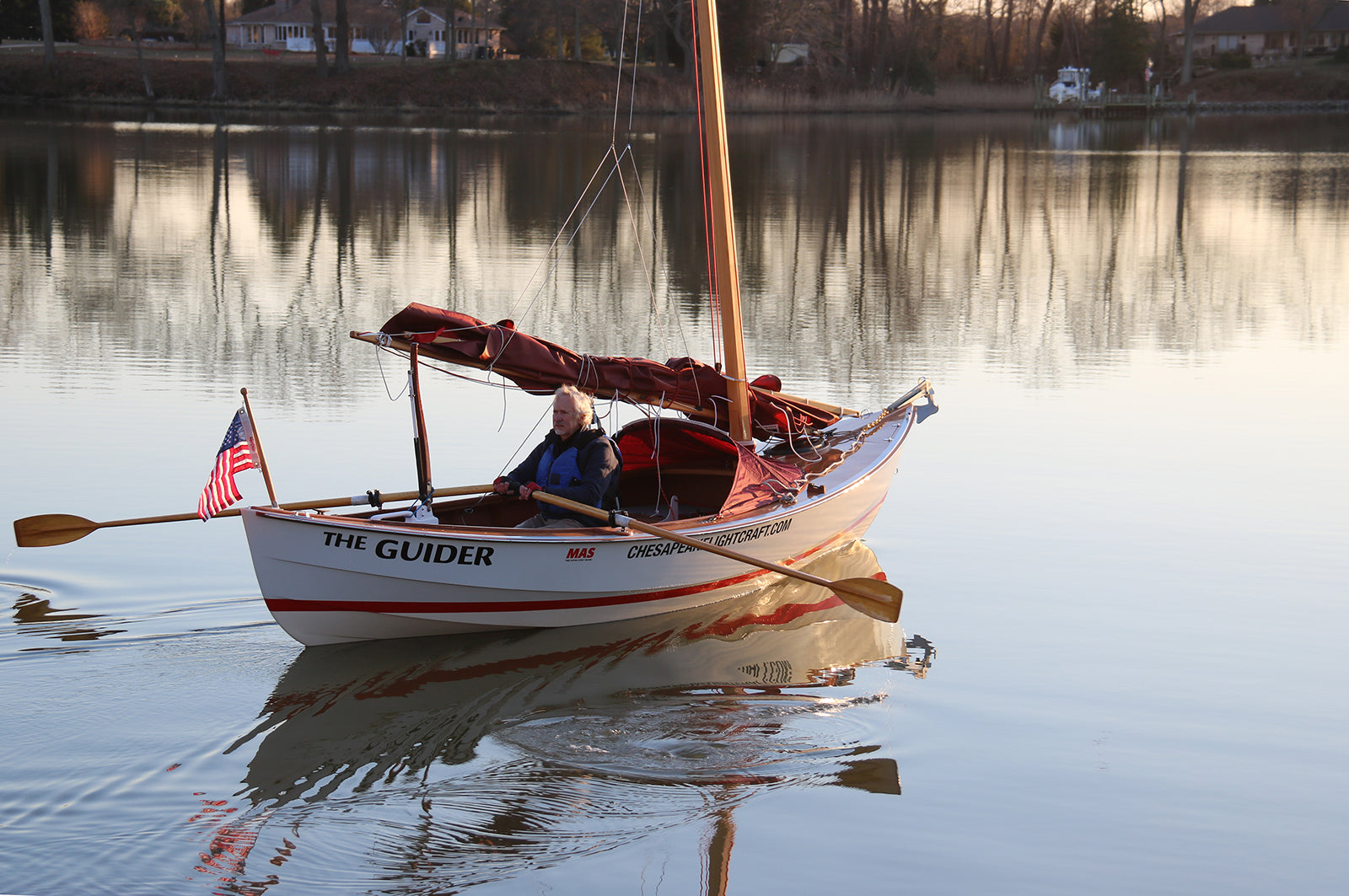
For a lugger that size, you need "lazyjacks," visible in the photo above. Lazyjacks corral the lowered spars and sail into a sort of hammock of lines, and suspend the bundle at a convenient height above the deck so that the crew can row the boat and live in the cockpit. Lazyjacks are simple enough in concept, but at this scale require some thought. They're lifting the same weight as the halyard, so they require a multi-part purchase, too. You have to make the lazyjacks easy to rig at the launch ramp, a detail I have fumbled in several designs this size. It's a lot of strings to disentangle.
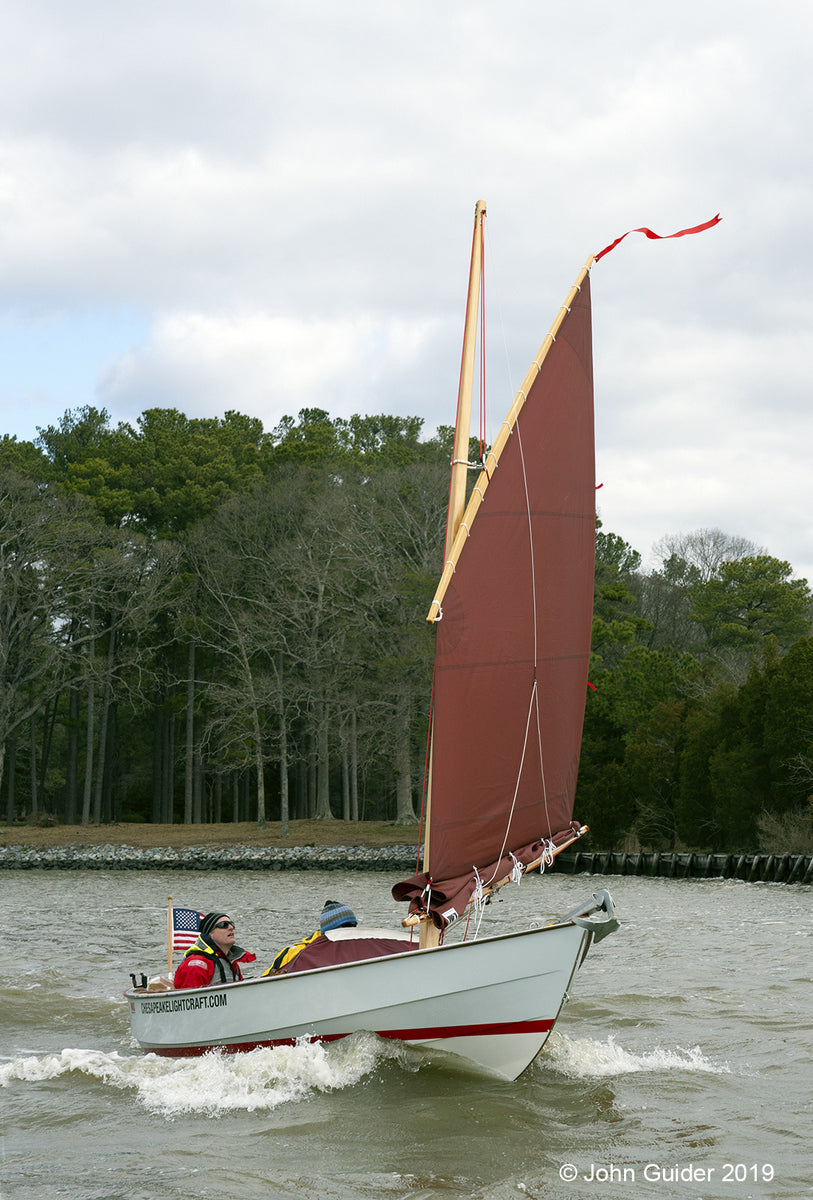
Here's the Guider boiling along in about 25 knots of breeze, which brings us to reefing big lug sails.
The stock 62-square-foot balanced lug sail shared by the Skerry, Passagemaker, Northeaster Dory, Tenderly, and others in CLC's fleet, can be reefed—made smaller on windy days—in a couple of minutes with a few yards of 3/16-inch line. The operation is so simple it scarcely bears mentioning.
Double that sail area, and reefing is no longer a trivial job. And you'd better make it easy, because the consequences of carrying too much sail in a big expedition machine like the Guider can ruin your summer. (Ask me how I know.) You need to flatten the 3D airfoil shape of your sail as you reef in strong winds. That means stretching the tack and clew outhauls good and tight when you reef. (Get that one detail wrong and a baggy sail can capsize the boat.) Okay: that means integrating 2:1 purchases for the tack and clew. The Guider has a first and second reef, so that's four cheekblocks and four cleats, the cleats positioned somewhere within safe reach of the crew when the boat is bucking wildly in a nasty chop. It took a thousand dollars' worth of hardware and several rounds of refinement on the prototype Guider.
One last look at that photo, above. That's me on the left. I'm at the helm, and I'm staring uneasily at the point on the mast where the yard crosses it. See that little loop encircling the mast, keeping the yard snug against it? That's called a "parrel," and on a windy day with the rig loaded up, it's under massive strain. If it breaks, that 11-foot yard will be free to gyrate. I'd lose a lot of sail control, not something I wanted to happen in cold water with 30-knot gusts. The parrel in the photo was a length of Kevlar-cored rope, threaded through a bunch of wooden beads so it would slide easily up and down the mast. That parrel was strong, but these luggers are powerful sails and it was a gust or two away from breaking and ruining my day. When we got back to the shop, I made up a new parrel, this time threading the beads onto a loop of stainless-steel wire.
And that, in case you were counting, was exactly 673 words detailing the complexities of rigging a BIG balanced lug sail. It rivals or exceeds the rigging requirements of a racing dinghy of similar size! I've drawn three boats with big lug sails and will hesitate before I draw another.
NOTE: Please don't write in about how the Chinese lug, or "junk" sail, solves all the problems of large lug sails. It both does, and does not, and to explain why would require another 700 words. Keepin' it simple here, folks.